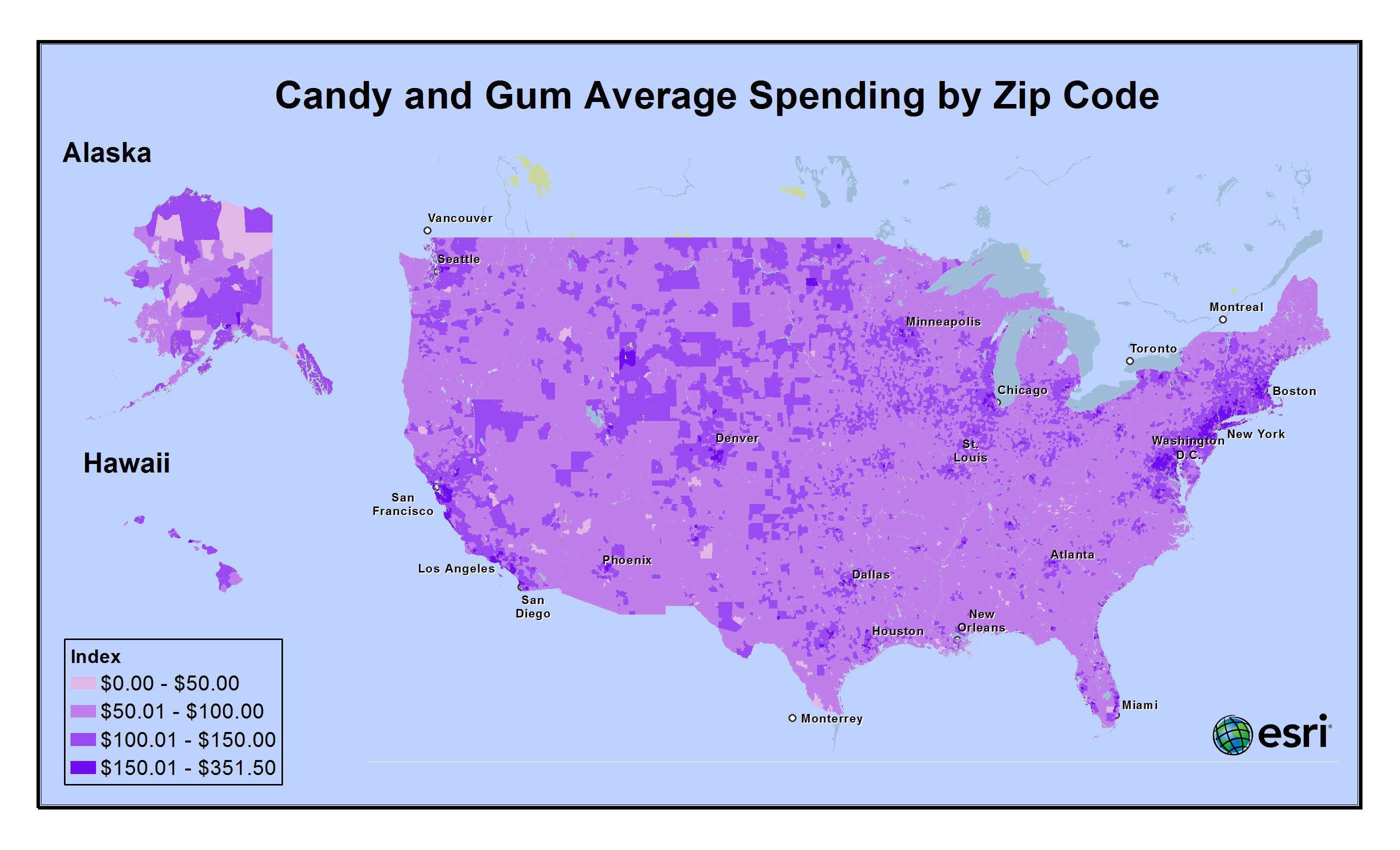
Americans love junk food – perhaps too much. Disney announced yesterday that it is going to limit junk food ads on its kids-targeted stations and only advertise products with minimum nutritional standards. (link) This is important as nutrition has decreased and obesity has increased. According to Esri, the average American household spends $101.45 annually on candy and gum. That’s a lot of sugar! Who is buying the most? Is there certain candy that is more attractive to a certain type of person? Are there areas or specific types or people that organizations can target advertising and healthcare to reduce this consumption?
The highest amount of spending on candy and gum per household is on the eastern seaboard and a few California coastal cities in California. This shows that although many Californians are healthy, many like to eat junk food too. In these areas, people spend at least $150 annually on candy and gum – and as much as $351.50. One of the zip codes that has one of the highest average amounts per on junk food is 07078, which is in Short Hills, NJ.
One method to classify consumers is through tapestry segmentation. Esri, a geographic information systems company which also does data analysis, developed a tapestry segmentation that classifies US residential neighborhoods into 65 unique market segments based on socioeconomic and demographic characteristics.
The tapestry segments that spend the most, on average, on junk food are Top Rung, Connoisseurs, and Suburban Splendor. 95% of neighborhoods where Top Rung is the dominant tapestry segment spend $200 or more annually on junk food. Residents of Top Rung neighborhoods are mature, married, highly educated, and wealthy. At least 95% of the neighborhoods where Connoisseurs and Suburban Splendor residents are dominant spend at least $150 or more per year, on average, on junk food. Residents of both of these neighborhoods have median incomes of over $120,000.
The tapestry segments that spend the least on junk food, on average per year, are City Commons, Modest Income Homes, and Southwestern Families. At least 97% of the neighborhoods where those are dominant spend an average $75 or less annually.
The type of candy people like varies across the board. Although I don’t have data for specific brands, data is available for candy categories.
Hard Roll Candy
Hard roll candy is things like Lifesavers and Werther’s candy. Basically candy that you suck on. The areas where people are most likely to purchase it are in various parts of Arizona, South Dakota, and a few areas around the south. One of the zip codes with the highest indexes for purchasing hard candy is 38631, which is in Friars Point, MS. Its index is 188 meaning a household in this area is 1.88 times more likely than the average American to purchase hard roll candy. The dominant tapestry group in this zip code is Modest Income Homes.
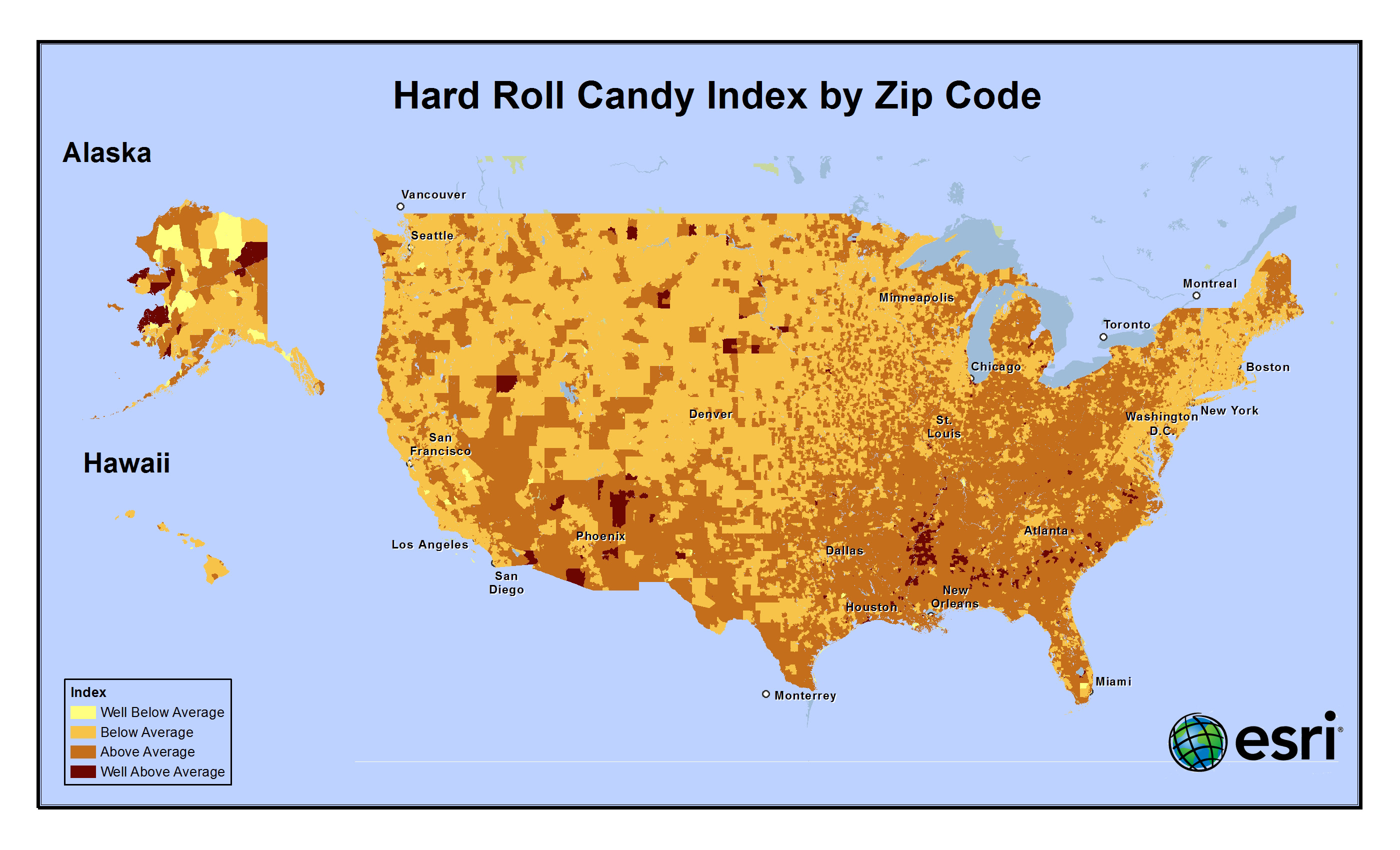
Certain tapestry segments seem to like hard candy more than others. The tapestry segments Modest Income Homes, Metro City Edge, City Dimensions, Family Foundations, City Commons, and Urban Rows all have indexes of 150 or higher. This means that residents of these segments are 1.5 times more likely than the average American to purchase hard roll candy. City Dimensions residents, for example, are young with a median age of 29.5 years. They are a diverse group with nearly half white, one-fourth black, and one-third Hispanic. Their median household income is $26,383.
Prepackaged Loose Candy
Many consumers like to purchase pre-packaged loose candy. This enables them to choose from multiple varieties so they have choices when eating the candy. There are very few places that have high index for prepackaged loose candy. One of the places with the highest indexes in 19142 in Philadelphia, PA with an index of 138 meaning a resident of that zip code is 1.38 times more likely than the average American to buy prepackaged loose candy.
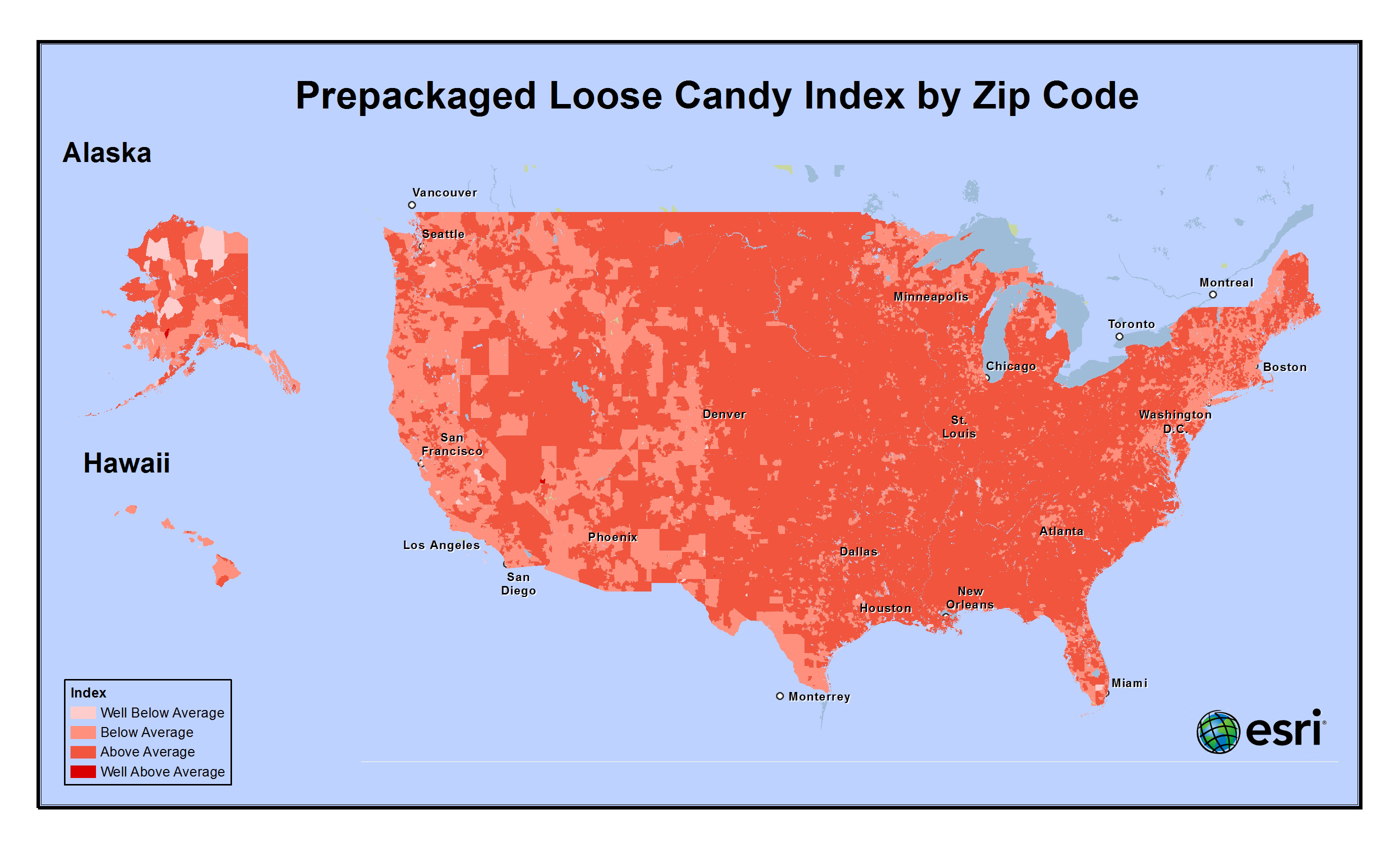
A few tapestry segments standout in having more residents interested in prepackaged loose candy than others. They are Metro City Edge, Modest Income Homes, Urban Rows, City Commons, and Crossroads. The index for each of these segments is 125 or higher meaning they are 1.25 times more likely than the average American to purchase prepackaged loose candy. The first four segments are also big consumers of hard roll candy. Crossroads neighborhoods, the segment without big consumers of hard roll candy, are growing communities in small towns in the South, Midwest, and West. They have a median age of 33.6 years; nearly half are younger than 45. One in five is Hispanic, a higher proportion than the United States.
Several tapestry segments stand out as having few residents interested in purchasing prepackaged loose candy. They all have an index of 75 or less meaning they are 25% less likely than the average American to purchase loose candy. The segments are Dorms to Diplomas, Laptops and Lattes, Top Rung, Trendsetters, Urban Villages, Urban Chic, and City Lights.
Regular Sized Candy
Regular sized candy is purchased by all types of consumers. In fact, there is little variation throughout the US in terms of likelihood to purchase. Zip code 36115 in Montgomery, Alabama has one of the highest indexes of 123. This means a resident there is just 23% more likely to purchase regular-sized candy, which is pretty close to average.
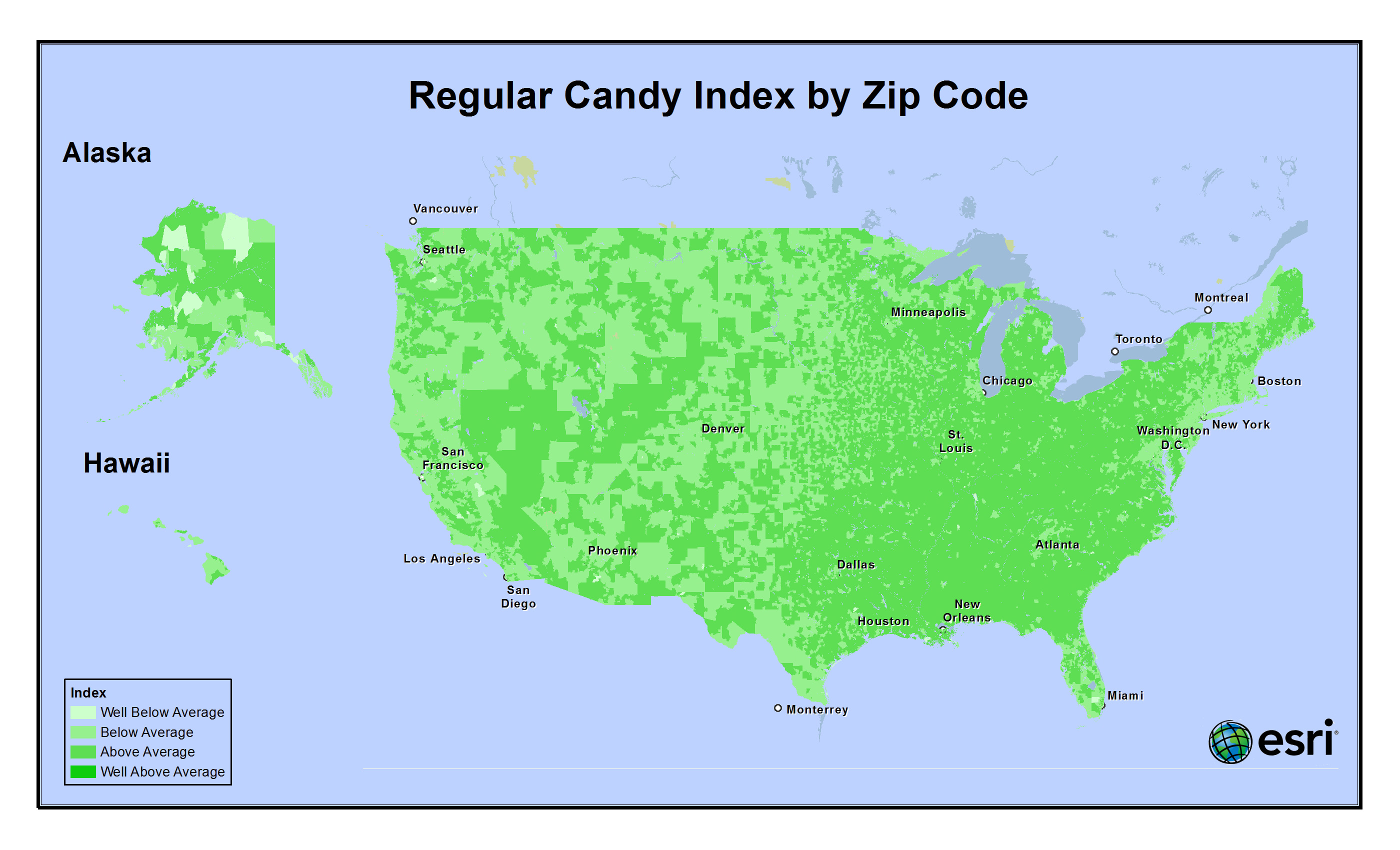
Because the indexes for regular candy don’t vary much, tapestry segmentation doesn’t really work. In fact, all zip codes have indexes between 82 and 124. For candy manufacturers – it just means they need to better understand exactly which type they are buying since size doesn’t matter in this case.
King Size
Many consumers love to buy king-sized candy as it is, well, bigger. And it is often a better “deal” than regular sized candy – at least for the pocketbook (not so much the belly though). There are a handful of zip codes where king sized candy is more popular than others. Interestingly, this includes some zip codes in Alaska (they need the warmth there?) as well as in Arizona, Louisiana, and South Dakota. One of the zip codes with the highest indexes is 92055, which is camp Pendleton, CA. The index there is 205 meaning residents are 205 times more likely than the average American to purchase king sized candy.
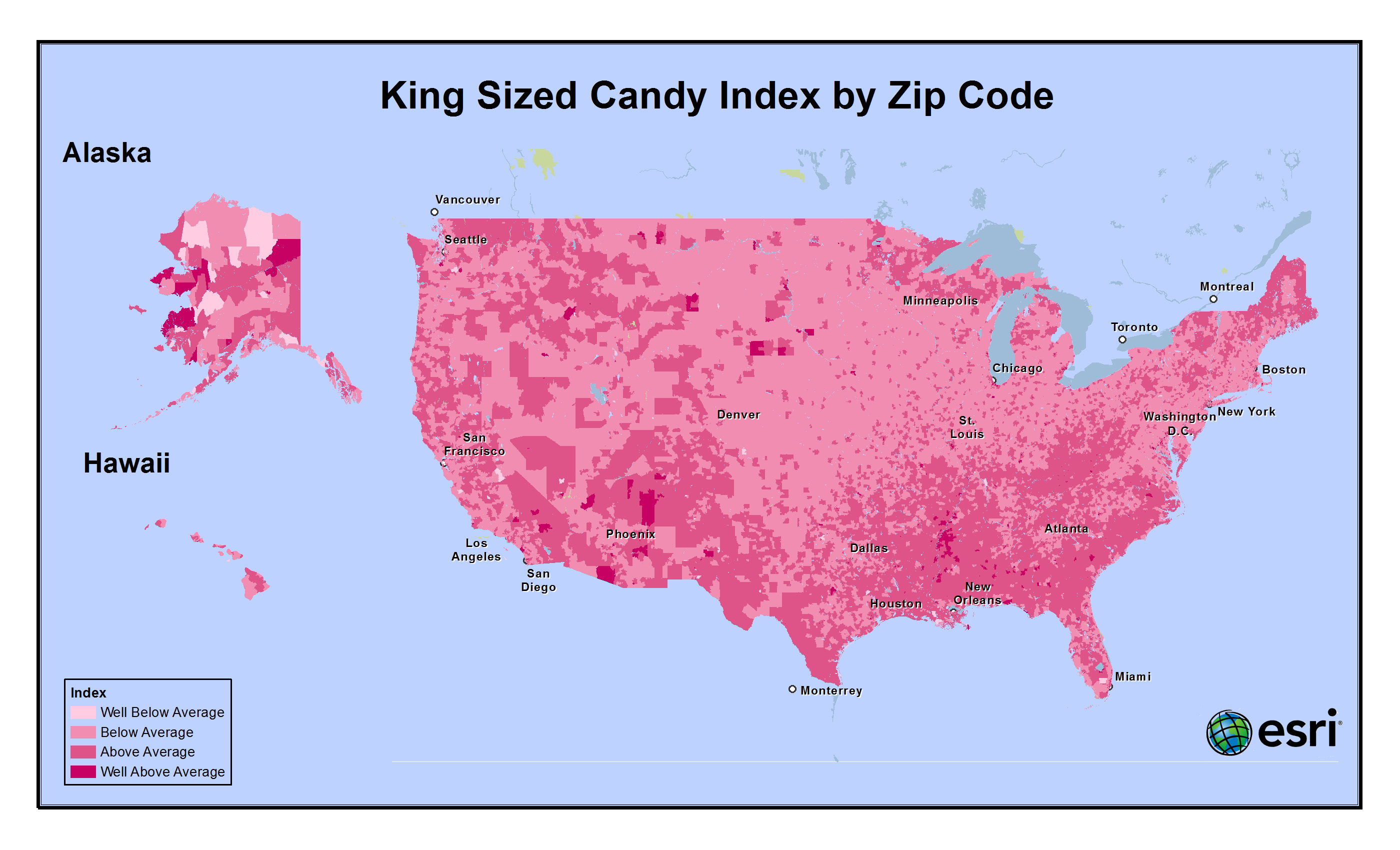
The tapestry segments that are most likely interested in purchasing king sized candy are Metro City Edge, Urban Rows, City Commons, Inner City Tenants, Military Proximity, and Modest Income Homes. This is very similar to the tapestry segments who like to buy hard roll candy and prepackaged candy. The exceptions are Inner City Tenants and Military Proximity. These groups seem more interested in king sized candy. Inner City Tenants residents are a microcosm of urban diversity; their population is represented primarily by white, black, and Hispanic cultures. Their median household income is $30,873. Military Proximity residents are young, married, and beginning parenthood. More than three-fourths of the labor force are on active duty or have civilian jobs on military bases.
What does all this mean? Well, it means that some groups eat or want candy or junk food more than others. The tapestry groups are not necessarily segmented by weight or obesity but this analysis can help you identify who is likely buying junk food, which can aid in advertising (and where to offer) more healthy alternatives.
More information about Esri’s data can be found at www.esri.com/data or to learn more about Esri in general, go to www.esri.com.


Leave a Reply